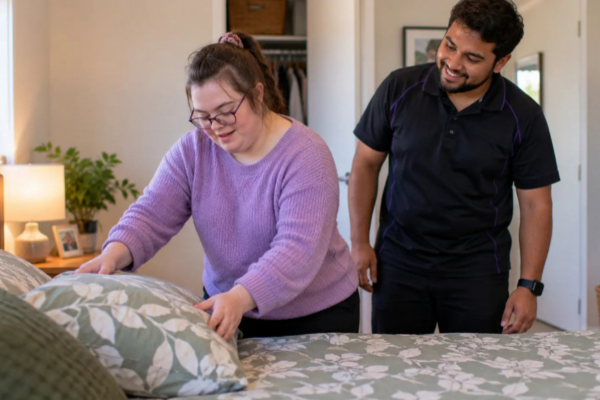
This online course supports disability support workers and providers to understand and apply the new NDIS Supported Independent Living (SIL) Practice Standards. It explores the four SIL-specific standards: supported decision-making, safeguarding, practice governance, and tenancy, housing and support arrangements and what each means in the everyday reality of a participant's home. The course examines dignity of risk, professional boundaries, power imbalances, restrictive practices, active support and trauma-informed care, helping workers recognise the difference between supporting a decision and substituting their own judgement for a participant's. It also equips organisations to demonstrate that their policies, training and supervision translate into safe, respectful and enabling practice, rather than compliance for its own sake. Throughout, the course encourages workers and providers to move beyond asking "Do we meet the standard?" to asking "Does the participant experience the difference?", building a workforce and a culture that genuinely support people to live their own lives, in their own homes, on their own terms. Read more
Content
Price

.png)
This Tracheostomy Care course provides disability support workers with the essential knowledge and skills to care for individuals with a tracheostomy. The course covers an overview of the respiratory system, tracheostomy components, and the necessary equipment for effective care. Participants will learn about tracheostomy management, including how to follow the healthcare plan and meet NDIS Practice Standards. The course also addresses potential complications, infection control protocols, and the legal considerations involved in providing safe and competent tracheostomy care. Equip yourself with the confidence to support individuals with complex respiratory needs. Read more
Content
Price
.png)
This online course empowers aged care professionals to deliver culturally safe, trauma-aware, and healing-informed care to Aboriginal and Torres Strait Islander Elders. Rooted in respect, truth-telling, and deep cultural understanding, the training explores the ongoing impacts of colonisation, intergenerational trauma, and the unique experiences of the Stolen Generations. Participants will develop a profound appreciation for cultural competence, learn how to recognise trauma-related behaviours, and apply strategies that foster trust, dignity, and cultural autonomy in care settings. Designed to align with Aged Care Quality Standards and promote inclusive, person-centred care, this course is essential for anyone supporting First Nations Peoples in aged care or health environments. This course has been mapped to the Aged Care Quality Standards: 1.1.2, 2.1.5, 2.1.6, 2.2.2 & 5.1.3 Read more
Content
Price

This essential course is designed for aged care workers who want to deepen their understanding of trauma and deliver care that promotes healing, safety, and dignity for older individuals. You’ll explore practical strategies to recognise trauma responses, avoid re-traumatisation, and create supportive, person-centred environments. This course has been mapped to the Aged Care Quality Standards: 1.1.1, 1.1.2, 2.3.5, 3.2.1, 3.2.2, 3.2.5, 3.3.3 & 7.1.3 Read more
Content
Price

In this course, you will explore the critical role of the skin in wound healing and gain insights into effective infection control and prevention strategies. You will learn to identify various wound types, including acute and chronic wounds, and understand the principles of moist wound healing. Additionally, the course will cover the factors that influence healing, the importance of accurate documentation, and the legal considerations associated with wound care. Join us to enhance your knowledge and skills in this essential aspect of healthcare. Read more
Content
Price
.png)
This Ventilation Support course provides disability support workers with essential knowledge and skills to assist individuals requiring mechanical ventilation. The course covers key topics, including the respiratory system and respiratory failure, as well as an understanding of ventilator parameters and how to monitor them. You will learn to recognize the need for suctioning and follow infection control protocols to ensure the safety of those in your care. Additionally, the course covers the health care plan, NDIS Practice Standards, and legal considerations, ensuring you are equipped to provide safe, compliant, and person-centered support. Read more
Content
Price
Shopping Cart
Your cart is empty